To the Child We Couldn't Grieve

The other Friday, your mother and I went to a live rumba concert at Artcaffe Gastro in Imaara Mall, to dance to Les Wanyika and possibly, if the ancestors allowed it, make merry with alcohol till we’re too inebriated to remember your absence. It was Jamhuri Day, a national calendar holiday when we as a nation pretend to be the bastions of patriotism and not just some mofos who would ditch this country in a blink if the colonisers approved our visas. It had been exactly one week and two days since we lost you. We had fretted over leaving the house to go anywhere, because we knew we would have to play insouciance for the public and even for those who knew us, who wouldn’t know how to condole over a loss like ours.
In the culture of my Luo people, your loss is never truly a loss to grieve, but merely a happenstance. Just bad luck—masira! Like meeting a black cat on the road in the morning, or balding before you turn 30, or buying an avocado that looks fresh on the outside but is rotten inside. A loss like yours isn’t even remarkable enough to be called death. It’s merely something to be noted, never distinguished, never honored. Yet the absence of you gnawed at our heavy hearts that Friday, eating away the air beneath our feet so we felt like soulless ghosts hovering hauntingly over this plane, unable to reach the big light. We carried your absence with a resolute tightness. We begged time to lick our memories dry. We leaked sorrow wherever we went. We didn’t know how to grieve, or if we should. So that Friday, we sat in an Uber and asked to be driven to Imaara Mall. Maybe when we got there, we thought, the universe would show us what to do when you can’t even name what you’ve lost.
You were never awake, my child.
*
What was I to say when Min Jii, my mother, said to me, after I broke the news to her: Mano ne ok ochanore ni obed maru, rit uru machielo (that one wasn’t meant to be yours, wait for another one)? But you were ours. You were mine. You were mine from the moment I first heard about you on that hot September Sunday afternoon. Nairobi’s sweltering sun, as if by some anomaly of nature, hung just low enough to transform this city, whose name literally translates to ‘a place of cool waters, ’ into a boiling mess of putrid filth. At a restaurant standing six floors too close to the sadistic sun, I sat opposite a man whose name I carry, and you, following the line long set by our ancestors, would have carried as well. I guess it’s fitting, poetic even, that I became a father in the company of my own.
Up here, the conditioned air settles lightly on our skin as we wait for our meals. We sip cold mango juice and talk about things, about life, and about this city my father first came to as a five-year-old boy. Now he points to a skyscraper whose construction he claimed to have overseen as the all-powerful foreman long ago, before anyone ever said Nairobi Lazima Iwork (Nairobi Must Work). Now he points to a spot along Moi Avenue, where he claims to have witnessed Tom Mboya gunned down. My father was only eight years old when Mboya, Kenya’s independence golden boy, was murdered by the people who own most of the skyscrapers in Nairobi today, including the one father proudly claims to have constructed. I would never dare call my father a liar, but I’ve known the man for over two decades, and during that time I have never met anyone who more relishes exaggerating facts. He was alive at the moment of Mboya’s demise—fact. He was in Nairobi when the assassin’s history-bending bullets rang out across the streets—fact. But that’s just where the facts end. Anything more is merely a product of my father’s very imaginative mind. But it’s not my place to call out my father for anything. It’s my place to sit quietly while he gathers stories from the nooks of his ancient brain, nod solemnly when he lies to my face, and punctuate any attempt at a dry Dad joke with respectful laughter. It’s the law. I would have accepted nothing less from you.
“I guess it’s fitting, poetic even, that I became a father in the company of my own.”
Soon, our plates of ox-tail stew and brown ugali arrive. This is an establishment that super-serves its niche, which is why the menu is littered with such dishes as Alia, Athola, Rech Manumu, Obambla, Aluru, Alot Mitoo, Alot Dek…delicacies that were first cooked on the shores of Lake Victoria and served to tall, dark, and proud thuondi who knocked down their six lower teeth in an act of brutal braggadocio, who rode into battle with shields made of hippopotamus skin and faces smeared with red earth. I find it necessary, even now, to point out the glorious and gallant lineage you descend from. Have you met them on the other side, your ancestors? Do they teach you how to sing Sigalala and gueyo? Do they show you how to appease the spirits of Juogi? How to chase death with spears and arrows?
Even the music that punctuates the atmosphere is very specific in this establishment. A particularly political song by the late Luo Benga maestro Ochieng Kabaselle engulfs the restaurant like an expensive perfume. I grew up listening to Kabasele with my father, and his voice—a controlled tenor, thick as hot honey—is just as I remember it. The sombre trumpets are like raindrops against the parched Earth, while the strings of the rhythm and lead guitar absorb every droplet and then spout them out like a monster whale. A master poet, Kabaselle preludes on a ruse of a love song, but the political undertones are unmissable. At the song’s crescendo, the musician openly mocks Moi’s dictatorship, laughs at his prisons where the dead dictator tortured his detractors, calling them merely simba yawuoyi (boys’ huts), where every man worth his balls has been in and out of. The postlude is an affirmation, a prophecy of a utopic future. One day, the musician says, we will wake up with hawi (luck), find peace, and be happy and content. How wrong he was. For Moi was never a man, my child; he was a spirit, and our culture teaches us that spirits never die, they are reborn. We have so many Mois running the government today.
You see, child, fathers pass a lot of things to their kids: ancestral spirits, propensity to diabetes, premature balding. But perhaps the most important inheritance a father can ever pass down to an offspring is a taste for art, music, beauty. My father bequeathed my taste for poetry and rumba music. Is there beauty on the other side, my child? Do they teach you music? Poetry? Can you recite Henley’s Invictus off-head? I recited the poem by heart after the doctor who showed us your heartbeat told us about its absence… “In the fell clutch of circumstance / I’ve not winced nor cried aloud / Under the bludgeonings of chance, my head is bloody but unbowed.” I lie to myself still.
Down the streets, I watch mortal men trudge their chaotic, uncomprehending lives under the unforgiving sun. Endless columns of broken people making their way to nowhere. Haggard and hardened, they look like miniature ghouls with all the pushing and prowling and proding and probing. They forget to catch their breath; they race to catch their own death. This life is their prison, and unlike Moi’s prisons in Kabasele’s song, one they cannot just walk in and out of. The sun sits still across the sky. But Nairobi never stops. This city is always moving.
Despite the heat, the giant jacaranda trees reach up to the skies, sprouting purple and lavender flowers that seem to whisper fuck you to the torrid sun. My old man calls for dessert. My phone buzzes. A WhatsApp message pops up on the screen. It’s a picture of a pregnancy test kit with two red lines. And my heart burst into crimson colors. I’m 27 years old, and the only thing I know about being a father is having one. And that’s hardly a practical experience. The air in the cozy joint became stiff as a wall. A thin layer of sweat peels off my skin. I see myself reflected in my father’s eyes, and I know I will love you with everything I’ve got. But in my Luo culture we don’t count our chicks until they are hatched, so I do not tell my father about you. I fake a headache, and excuse myself to go be a father.
*
Most cultures have a clearly defined line between boyhood and manhood, and with it come elaborate rites that mark the boy-to-man transition. Some cultures mutilate genitalia. Some send their soon-to-be men into the jungle to wrestle with lions. Some have them ride whales. In my Luo community, they would knock out a boy’s six lower teeth to signify that his balls could now fill his hands. We don't do that anymore. These days, a mother just stares at a boy’s bulging muscles weirdly and says, “Anto kik iloka dayo sani owada” (don't you dare make me a grandmother right now). There’s no missing it when a boy becomes a man.
But there are no rituals for becoming a father. No acknowledgement. No initiation. No one paints red Earth on a man’s face and declares him father. There are no elders with white mushy hair to sit him around a bonfire, offer libation to the ancestors, and officially usher him into fatherhood. There will be no hormones surging inside him for months, reengineering his physiology and psychology in readiness for the impending fatherhood.
But then there are those two red lines on a thin paper. The soft-spoken sonographer will point to a screen, at this odd-looking form, and say, “Here’s your baby.” I’ll hear its heartbeat, loud and confounding. A mighty torrent of emotion will wash over me, flooding every crevice in my being that knows pleasure. And I will want to protect that tiny form with every breath in my bones.
*
I hear it’s at the brink of death, when you’re staring down the dark pit of your own mortality, that you can, even if only briefly, tap into the person you really are—all facades and pretenses stripped away. Is being a father akin to dying? I imagine it should be. Creation, after all, is the other side of death. But what do you know? You never even lived.
We—your mother and I—meet ourselves on the dance floor of Les Wanyika that evening at Artcaffe Gastro. The air is a thick concoction of coffee, beer, and various body perfumes. Les Wanyika begins with the timeless love song Afro. “Afro oh, Afro mama eh, mtoto wa Sagana mama.” It’s 2025, but it’s almost like the band has been transported back in time—to their heydays in the 1980s—with the rest of us. Today, most of the band members are newbloods. But I can see it in the eyes of the last-standing oldies—the unassuming trumpeter and vocalist Sijali Salim Zuwa and the virtuosic bass guitarist Tommy Alfani Malanga—a reflection of a nostalgic past, a yearning for the things long swallowed in time, grief over their lost vitality and their fallen comrades. But also triumphant joy to be here now, to be able to look back in time with pride and a creased face.
“But there are no rituals for becoming a father. No acknowledgement. No initiation. No one paints red Earth on a man’s face and declares him father.”
I look at these two legends—Malanga and Zuwa—and can’t help imagining what it must feel like to entertain a multigeneration, to play for the kids of the kids who once worshiped at their altar.
“Afro wa Kirinyaga Sagana nimeridhika kuwa na wewe.” The embalming chorus is like the sound of cattle susurrating on lush green fields. The moment feels like graying old friends sitting by the fire. Like the smell of the yellow pages of an old novel. Smoke rising from a grass-thatched hut on a cold evening. A tipsy couple at 3 a.m., dancing to the beat of their own hearts. Listening to Kamau Munyua talking to himself on Radio Citizen at 10:30 p.m. on Sunday. Maasai Mara sunsets. Quiet.
Your mother and I hold hands, each reassured in the other's emptiness, and yet repelled by it. We hold each other in an unstable whirl, trying hard to keep each other’s feet on the ground. Our skin is cold to the touch of our fingers. We try and fail to gather memories of the castles we had built in the air; the smile you would wear, the nose you would balance, the mouth you would pout, the name you would carry, the dreams you would dream, the world you would carve for yourself.
When you were forming in your mother’s body, I imagine that you were asleep, just gliding in a dream. I imagine in your sleep, your perfect little spirit chose to abandon the forming flesh. Our ancestors decided you were just too precious to spend a minute longer in this mortal coil. So they called you back. You rose above the Earth. Above the murk and the turmoil of this big, blue, sad rock. Past all the stars in the sky and then into a light so bright. And then for the first time, you wake up. You’re wrapped in a feeling of love. You’re pure. You’ve never known fear, anger, turmoil. And you’re not alone. You’re home with our ancestors, those who’ve gone before us. My grandfather, Onyango Nyochieng’. My grandmother, Adorry Nyokeyo Nyakorando. My uncles, aunts, and cousins. They all love you and name you. You grow up in a blink, and you’re perfect. Your body is as it would have been on your best day on Earth. Your perfect age. The peak of yourself. You’re shrouded in love. And you’re happy, knowing I will join you there soon enough.
We’re young. We are trapped in a loop of grief. We’ve lost. We’re yearning for warmth, yet we push each other away. I try to wrap your mother in my frozen embrace, but she’s all broken; she has no form to receive me. We cry in each other's arms until we’re soaked. Les Wanyika’s Sina Makosa is missing Issa Juma’s thick baritone vocals, but the music is just as nostalgic, just right. We sing along till our voices are hoarse.
About the Author
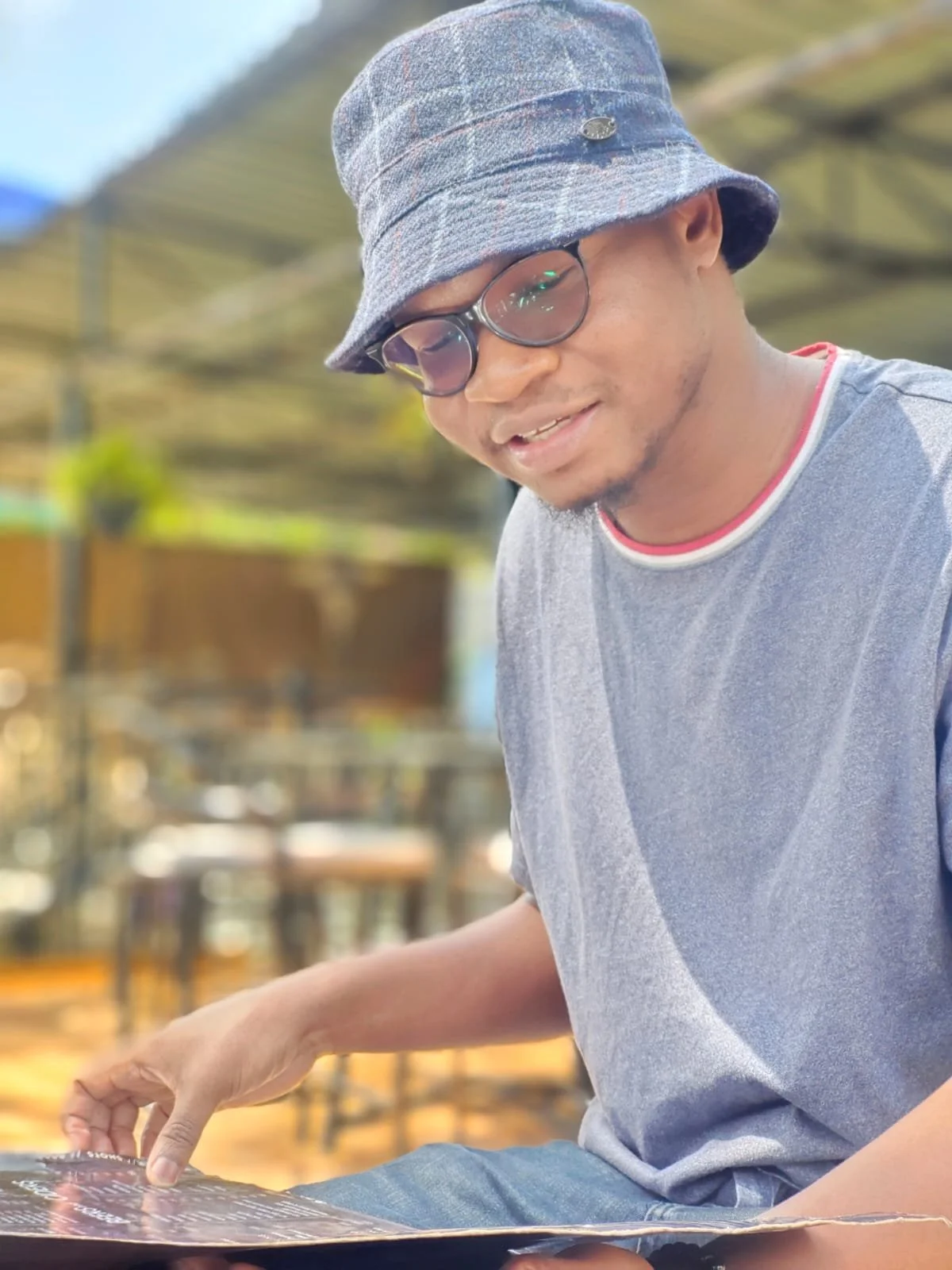
Tonny Ogwa is a writer from Nairobi, Kenya. His writing has appeared on The Republic, The Elephant, Sinema Focus, Will This Be a Problem? and elsewhere. He holds a full-time job as an advertising copywriter so he can pay bills, and writes in the dead of night like his ancestors would have wanted. He's yet to write anything that would give him the confidence to introduce himself as a writer in public, so for now, whenever he's asked what he does for a living, he just says "I work in advertising" (another reason why he works in advertising).
Read Tonny’s “Behind the Essay” interview in our newsletter.
Header image by Liana S.
Edited by Aube Rey Lescure.