To the Shopkeeper From Another Life
It is Ramadan 2012 when we walk into your shop in Tripoli. It has been some hours since the sun set and we broke our fast. This deep into the night, humidity persists, skin clinging to fabric. The entire nation is awake below a thin, glowing crescent moon. Storefronts and cars light up the city like a stadium. Young men set up foosball tables on sidewalks and play with a competitiveness fit for World Cup athletes. Horns blare. Men shout affably to one another from across the road. The casual term of endearment used between men, “Ya rajl,” charms each of their sentences. Clusters of women in colorful hijabs scour the shops for new Eid outfits. Children stamp along the uneven pavement like they own the night. The occasional cat darts beneath clutched shopping bags and cars stalled in traffic. It is less than one year since the triumph of the Libyan Revolution that toppled Muammar Gaddafi’s 42-year dictatorship. My family, who lost loved ones and homes under the regime, are optimistic about the future. My mother and I flew here this summer from California to rejoice with them.
“It is darling to see my mother as a daughter, if only for a moment.”
When we enter your store, the glaring lights from outside are replaced with a warm golden glow. Everything in here is immaculate—the slick tile floors, the sparkling glass storefront. It looks like a part of a palace. Mama, Khalti Ashraf, my cousin Sijoud, and I have come here together, and we are the only customers inside. We peruse the kaftans flowing from the racks, tracing the silk brocade and sequins with our fingers. You tell us you personally collected these items from Morocco, and we remark on their beauty—it is the kind of beauty that bears recognition.
One dress in particular catches Mama’s eye. She grabs it by the hanger and places it against her body. We join her in imagining how the dress will suit her, and we insist she try it on. You lead Mama to a corner of your shop, where the only fitting room available is a small space enclosed by a curtain. Before she disappears inside, you exit the store to afford her maximum privacy.
A few minutes later, Mama emerges from behind the curtain wearing the kaftan that looks like it was fashioned just for her. Mocha in color with gold embroidery, it drapes down to the floor with a slight flare. Mama extends her arms out to show off the bell sleeves. All of us adore it, but her excitement is what endears me most. Her smile holds the enchantment of a young girl. She changes back into her clothes and you return shortly after.
Mama asks you for the price. You tell her it is 500 dinars, a steep sum for a single article of clothing. But for once, she considers it. With little time left to pick an outfit for our relative’s wedding, Mama is antsy to show my grandmother the dress to procure her blessing. It is darling to see my mother as a daughter, if only for a moment. But my grandmother is at home, since navigating Tripoli’s roads with her walker, sometimes her wheelchair, is hostile and unpredictable with potholes the size of craters. And Mama does not have 500 dinars on hand—not even close. She barters with the weighty gold around her wrist, promising to bring the kaftan back to you tomorrow. She explains that it would be too difficult for my grandmother to journey all the way here.
I watch and listen to the familiar volley of insistences and refusals between you both, a dance of Libyan hospitality. You instruct her to take the kaftan home with her, as well as her jewelry. Mama declines your generosity, setting her bracelet on the counter, right beside the register. But you never touch Mama’s gold. As soft-spoken as you are, you demand with a resolve that Mama finally concedes to. This entire encounter is sweetened by the fact that it is happening in our unique Libyan Arabic, at once forceful and delicate, moving between guttural sounds and a swinging intonation so particular. In California, where I was born and raised, our dialect is one I grew up hearing only Mama speak. To listen to you, to the rest of the country, speak in the same way that Mama does, is to hear the idea of home she raised me with in every voice.
Mama promises to return the dress tomorrow, inshAllah. You tell her to take her time, and you mean it.
Mama did not end up purchasing the kaftan from you. I cannot remember why. She tried it on for my grandmother, who urged her to buy it. I suspect it was simply too expensive.
She should have bought it; it would have made the perfect narrative arc. But maybe perfection and resolution are not the point of this story. Perhaps the point is the fleeting, borrowed beauty we touch, and the beauty which touches us
*
I owe it to Mama that for as long as I could remember, Libya was a steadying force in my life. More than a place on a map, it was the place of my belonging. In California, where the only Libyans we knew were each other, Mama was as close as I would ever get to the home she left behind. She transported me there through her stories. Whimsical stories of her youth: seeing King Idris gliding along her street in a limousine; persuading my grandmother, who never got to finish school, to enroll alongside her at Tripoli University; the many times she drove the five minutes from her house to the sapphire coast of the Mediterranean; the morning after her wedding, when her little brother showed up at her new doorstep—alone and unannounced—because he missed her too much. These were Mama’s memories, but because of her, a version of them exists in me.
Mama’s affection for her homeland was palpable. The summer we met you in your shop, the Libya of her stories was reflected in my surroundings. My concept of Libya as a home became inseparable from being there with her. I only absorbed the weight of this the year after we met you, when she was murdered in California.
*
I remember the days after her death, how I cried, crumpled in a bedroom of a friend’s home. I was unmoored, severed from my mother and my mother’s Libya, helplessly drifting further and further away. I was desperate to relocate myself, to find my way back home. In a riot of rage, shock, and sadness, I clung to the idea of returning to Libya with a child’s yearning. I reeled between believing Mama was not truly dead—that she was somehow safe over there in Tripoli‚ and recognizing that although she was gone, going back to Libya would bring the same comfort to me as it had the year before.
But we had barely lowered Mama’s body in the ground in California before Libya began its own descent into darkness. The following year, the civil war erupted. My family’s neighborhood was seized by a rogue militia. Gunfire riddled Tripoli’s landscape. Sometimes a tank crept up their street. Constant power cuts gave way to the drone of generators. Our collective optimism from the revolution was mangled. Relatives who had the choice migrated to Tunisia, Egypt, Jordan, Italy, and elsewhere, their homes left vacant. The possibility of returning to the Libya I knew—or returning at all—faded.
During all of this, Mama visited me in dreams. It was always the same one: She glances at me through an opening, perhaps a window, but I cannot reach her. I want to say something—anything—but my voice eludes me. In the dream, I am at once relieved and hurt to find out she is alive somewhere else. She is safe in the Libya we had loved together. A dream was all my mother and my country had become.
*
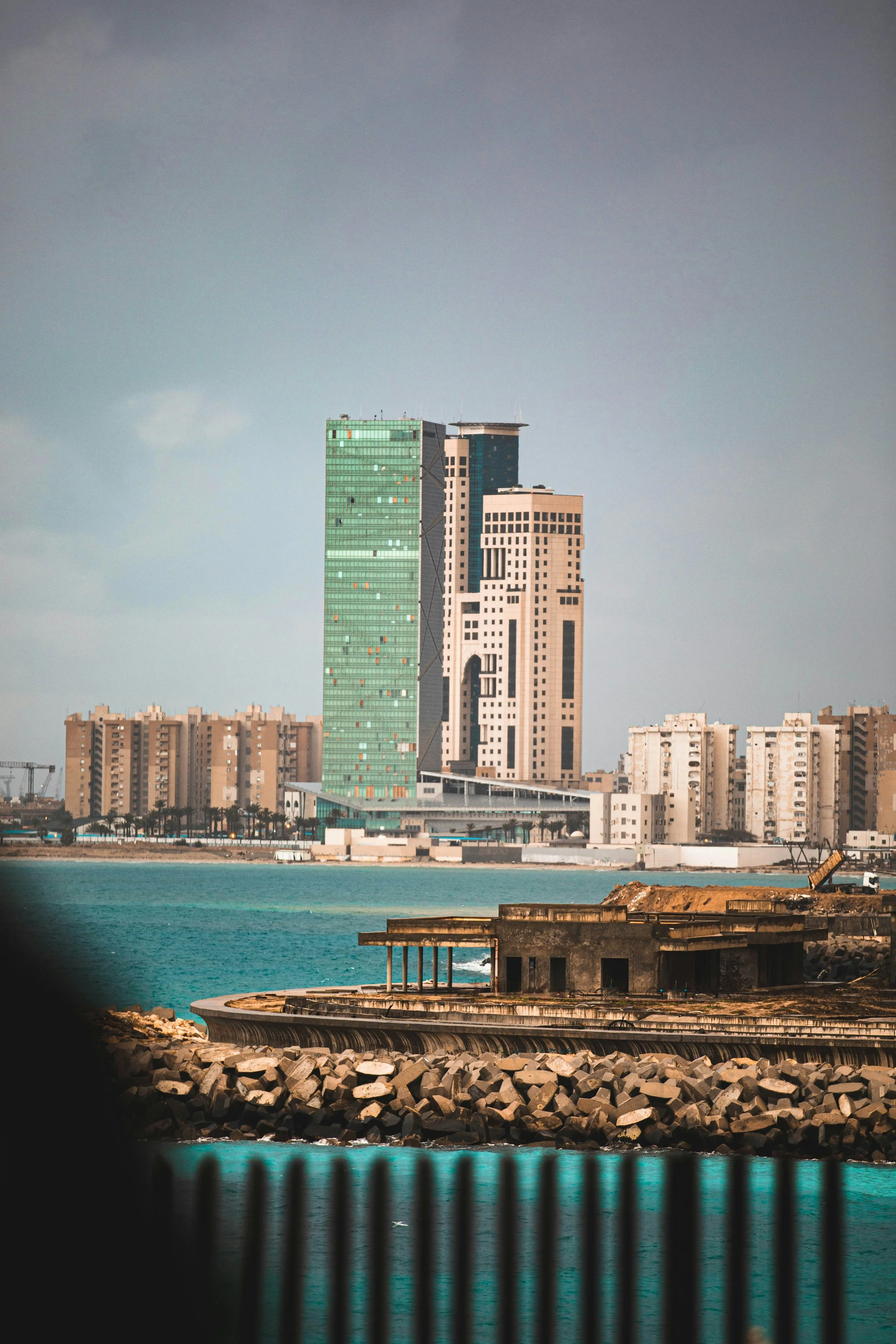
I finally return to Libya in December 2018. Khali Hasoona picks me up from the airport. The short ride to my grandparents’ house is somber. My return feels less like a homecoming and more like a pilgrimage. The roads are quiet, our headlights and the flickering streetlamps our only guide home. No one is out but for the rare car in the distance. Rhythmic static hums from the radio. We journey past the Red Castle, past the Medina, past the soaring minarets. The waves are fierce tonight, clawing onto the corniche as if the sea is trying to escape itself. Khali Hasoona has committed every pothole to memory, swerving this way and that. Libya is as desolate as I have ever seen it.
“I need their recognition that nothing is the same—I do not know how to move forward without this. ”
The moment I cross the threshold of Mama’s childhood home in Tripoli, I am ambushed by loss. Her absence is sharp here, sharper even than in the city where she died. My blood pulses with anticipation—I am waiting for her to reappear. Waiting for Libya to restore her to me with its tender magic. Waiting to become the seventeen-year-old girl I once was. This never happens, of course, and it feels like a betrayal. I cannot untangle this knot of spectacular delusion.
I enter the room where my relatives are gathered. Khalti Leila hugs me and does not let go for a very long time. Khali Hasoona shouts to my grandfather—who is hard of hearing and visually impaired—that I, Nadia’s daughter, have arrived from America. His inability to recall me or my mother becomes a wound. My grandmother had passed in 2017. We never told either of them how Mama died, but even the fiction of a car accident did not spare my grandmother, and she suffered two life-altering strokes shortly after.
Grief marks my entire family. I feel a distance between us that I do not know how to bridge. Some seem so altered that I spend our interactions hoping to find a piece of who they used to be. Strangely, I find myself wanting to quantify how much of that is due to the civil war or to Mama’s murder or to something else entirely. I want to know what has broken them and to what degree, as if this knowing could somehow contain the boundlessness of our grief. This pain settles in unspoken ways. We do not talk about the war, and some steer away my attempts to talk about Mama. I need their recognition that nothing is the same—I do not know how to move forward without this. But there is no anger, no sorrow, that reflects back to me.
On warm days, the Libya beyond the walls of the house bears a striking resemblance to the one in my memory, with crowds once again overtaking the markets, and the same blaze of sunlight. It is as if I have paused a movie and come back to resume it only now, years later, nothing feels the same anymore. My relationship to Libya collapses beneath the enormity of my mother’s absence. A melancholy stretches across the city like a second sky.
Standing on the roof that overlooks the city, a warm breeze whispers around my limbs. I shut my eyes tight and imagine Mama in Khoms, her birthplace. We walk for hours through stunning Roman ruins until the stone floor splits into fragments, until all we are trudging through is hot, stubborn sand, and we end up on a beach. I see her there, neck-deep in the open sea. I see her beside the white Ottoman clocktower in the heart of Tripoli, sipping a cappuccino after a long day of fasting. I see her in my grandmother’s kitchen, making pizzas at two in the morning for me and my cousins. I see her by the Algeria Square Mosque, where schoolgirls in pink hijabs spot the camera in my hand and swarm around Mama to have their picture taken with her, which delights her to no end. She is everywhere, and yet, she is nowhere at all.
Like you, my mother and my country are strangers to me. I no longer recall what street your store is on. If I did, I would return. I picked up this habit after Mama died: excavating every person and place that held a connection to her. Amidst all that I have lost, you have transformed beyond the generous shopkeeper in Hay al-Andalus. You are my portal to a past daughter, a past country, a past life.
About the Author
Nour Naas is a Libyan writer from Vallejo, California. Her work has appeared in The Globe and Mail, Huffington Post, Insider, Catapult, and elsewhere. Her storytelling is featured in the podcast, This Is Actually Happening. She is at work on a memoir. Find her at her website.
Read Nour Naas’s “Behind the Essay” interview in our newsletter.
Edited by Tusshara Nalakumar Srilatha.
Header photo by Moayad Zaghdani.