To the American Veteran at Cairo Airport
I was listening to “Church” by Coldplay, carrying the painting under my arm, that foggy Tuesday dawn at Cairo International Airport.
Over the years, I’ve gained certain travel habits. One of them is traveling at dawn. The habit began to take shape in 2003, just days before the American invasion of Iraq, when my family and I traveled to a village on the Iraqi-Iranian border. As we approached that safe haven, I remember seeing palm trees rising behind the fog. The trees were black, and the only sound was someone whistling inside the car. Were there actually black palm trees? Was someone really whistling? To this day, I haven’t asked anyone in my family about that drive to the border village. It’s a memory I locked away in a box and threw far away, but like everything we try to get rid of, it’s still right there, having traveled right back to us.
Then came our trip to Syria in 2006. That drive was at dawn, too. I remember the long desert road where I would fall asleep and wake up intermittently. I remember the hills and the vast, dizzying wasteland. I’d drift off while tracing the curves of the dunes with my eyes. The driver’s phone rang every now and then, the ringtone a clip from an old Egyptian series. Dawn turned into morning, then noon, then years slipped away. Our third move was to Finland. It was my first time on a plane, and I saw nothing outside the window because I sat in the aisle seat. I didn't know which sea, city, or mountain we had crossed to reach Helsinki. The flight to Finland was at dawn, as it was dawn when you called out to me, 13 years later, at the Cairo airport.
You asked if I was Greek. I said no, trying to stay in that half-asleep daze so I could fall asleep the moment I boarded. But you pushed further: "Where are you from?" Right then, I knew my sleepiness would be gone for the day. "I'm Iraqi-Finnish," I told you. I looked into your blue eyes and your thick, wildly arched eyebrows. Your eyes looked empty, despite the color in them.
You told me you had visited Iraq. For a fleeting second, I thought we might talk about Baghdad or the places you’d seen, the kind of small talk usually attached to a mention of a visit. But the moment shattered when, before I could even ask, you added that you were part of the U.S. Army that invaded Iraq in 2003. What you saw as a "visit" was, for me and every Iraqi, a butchering that stretched from that year into an unknown future. And again, before I could speak, you said, "Luckily, it helped you guys get rid of Saddam."
I told you the U.S. always thinks it wants to help the world without being asked, and there is only one kind of person who helps without being asked: someone who intends to steal.
Your facial expression remained frozen in an unchanging smile. You said that what the U.S. did was wrong, but that it had taken a toll on you, too, because you’d lost your buddies in battles against the Iraqi resistance.
“I told you the U.S. always thinks it wants to help the world without being asked, and there is only one kind of person who helps without being asked: someone who intends to steal.”
Your tone of voice indicated that to you, this was probably just a casual chat. To me, it felt like a rat running wild between the walls of my stomach.
After that, naturally, I had no desire to keep talking to you. Not just because you were one of the people who occupied my country and changed our existence there forever, but for another reason: I hadn't opened that wound yet. The unreadable smile remained on your face. You turned away and started tapping your fingers on the strap of the backpack hanging off your shoulder. Your blue jacket and jeans smelled faintly of sea salt.
*
The Iraqi-Iranian Border, 2003
This was a world I lived in for a few weeks and then left behind. I have nothing to take me back there. No photo, no phone number, not even an address, because the house we stayed in was bombed shortly after we left. It was a massive two-floor house; half of it overlooked the front garden, and the back half opened up to an orchard of olive and orange trees. A child back then, I explored every single corner of that orchard. It was there that I tasted fruit straight from the tree for the first time, fell from a branch and got a permanent scar on my elbows.
We played every day, all day long, except when it was time to eat or sleep. And when I say “we,” I mean myself and the maid’s children, as the family hosting us didn't have any children of their own. Perhaps that constant urge to play was just our childish minds responding to the anxiety heavy in the air. Every now and then, news would come from the neighbors that the area might be bombed within the next couple of days, which meant we had to stay inside the "safe rooms" of the house, where compressed foam sheets had been nailed to the walls and large tapes in X shapes were plastered over the windows to keep the glass from shattering inward if a bomb hit. The TV followed us like a living creature, sometimes in the kitchen, sometimes in the safe room, and rarely in its actual spot in the living room. It wasn't just us humans who were displaced; even the objects around us were out of place. The grownups glued themselves to Al-Jazeera channel, tracking the situation in Baghdad, which the U.S. military hadn't entered yet.
The first explosion came from a hill near where we lived. We kids hated the bombing, not because we were terrified, but because it locked us indoors for days, keeping us from playing. In fact, I don't remember us being scared the way the adults were. Sure, we felt a flash of fear during the actual blast or when hearing about mass deaths on TV, but that fear never lingered. It would slide away into some darker holes of our brains, hardening from raw fear into cold blocks, an internal icebox that would later turn us into frozen adults.
*
I kept walking toward the departure gate, set the painting on the seat next to me, and pressed play on the same music. I had only been listening for a few seconds when you sat down beside me again, telling me you wanted to show me something on your phone. After scrolling for a long time, you showed me a photo of yourself with a few male and female soldiers, with Saddam Hussein standing right in the middle of you all. I stared at the photo in shock.
It was a digital photo taken of an old printed photograph, so the quality was poor, but it was easy to recognize you and that same unreadable smile. Your head was shaved, just like it was now. But back then, your muscles were toned and defined. Now, you looked thin and your back was slightly hunched. You repeated yourself again: Saddam was a bad man and thank God we, as Americans, helped you get rid of him. That was when I pulled the earbud out of my ear, stared at you for a long time. Then I told you the gate was opening and I had to go.
*
I never expected certain stories to hound me my entire life, but I was wrong. That's just how life is; some moments happen, and they keep happening forever.
In Baghdad, in 2005, I was on my way home from school with my friend Rawan. She wanted to stop by a shop to buy a birthday gift for her mother. She was torn between a headband and a necklace with a Kaaba pendant. I recommended the headband because I always saw her mother wearing one. We were walking along the colored blocks of the curb (black, yellow, black, yellow) when a man rushed out of his house shouting: “They caught Saddam!” In an instant, the street erupted into shouting, cheering, and chaotic chatter. I still have this image in my mind where the street, from all the noise, seemed to blur into itself. My memory of that day feels like a handmade carpet with a continuous glitch in the weaving: There was a pattern, but I couldn't tell if the people were happy, sad, or just utterly uncertain.
*
It hit me right after I arrived at the Athens airport, just before I sat down in the waiting area: I no longer had the painting. A sharp shock went through me as I realized I had left it behind at the Cairo airport, and I would never get it back. The painting was a portrait of me, painted and gifted by my friend, the Egyptian artist Daniel, during my visit to his studio in Giza. I stood there for a second, trying to process that it was gone, and at that exact moment, I saw you in front of me again. You told me you were heading to Athens and asked where I was going. I gave a clipped answer: “Helsinki.” You reached out your hand to shake mine, introducing yourself as Sam, and said it was great that we ran into each other. I didn't shake your hand. I just replied that it wasn't a good coincidence for me, because I had lost the painting I was carrying back in Cairo. You expressed your regret and offered to give me one of the souvenirs you’d bought from the markets in Cairo to make up for it. I recognized you were trying to do something nice, but I told myself: Do what you always do when you’re torn. Trust your gut. And my gut right then told me: Don't take a single thing from him.
“And perhaps there is an even deeper wound that inflicts colonized people, resembling what Edward Said described as a double consciousness.”
While I turned away from you, another rush of memories flooded back to me: returning to our house after the war ended, and people crying in their cars as they watched the U.S. soldiers and tanks ruling the streets. The day they blew up the Al-Askari Shrine and the civil war that followed, the deep, jagged wound that haunts Iraqis to this day. And perhaps there is an even deeper wound that inflicts colonized people, resembling what Edward Said described as a double consciousness. In his analysis, colonized peoples fall into a trap of emotional contradiction toward the colonizer, blending resistance and rejection of dominance with a desire to mimic and resemble the colonizer just to gain their validation. But the wound I felt now was slightly different. It was the colonized person's attempt to appear tolerant and civilized to the very person who caused the occupation of their land, just to earn their approval all over again. That was exactly what I fought so hard not to do through the conversation you insisted on having with me.
I sat down, waiting for the gate to open. I looked over my shoulder as you walked away. This time I waited with no earbuds, no music, and no painting. Instead of these things, that deep pit called war and death appeared before me, the one that had always been inside me, but which I had never looked into before. I did not look directly and fully into it when I was at the airport, but it was enough of a glimpse that I realized it was there. As the days went by, I began to peer into it from time to time. Or perhaps it began to peer back at me. I’m not sure whether meeting you was a good thing, but I’m certain that it was a piece that had fallen into place.
About the Author
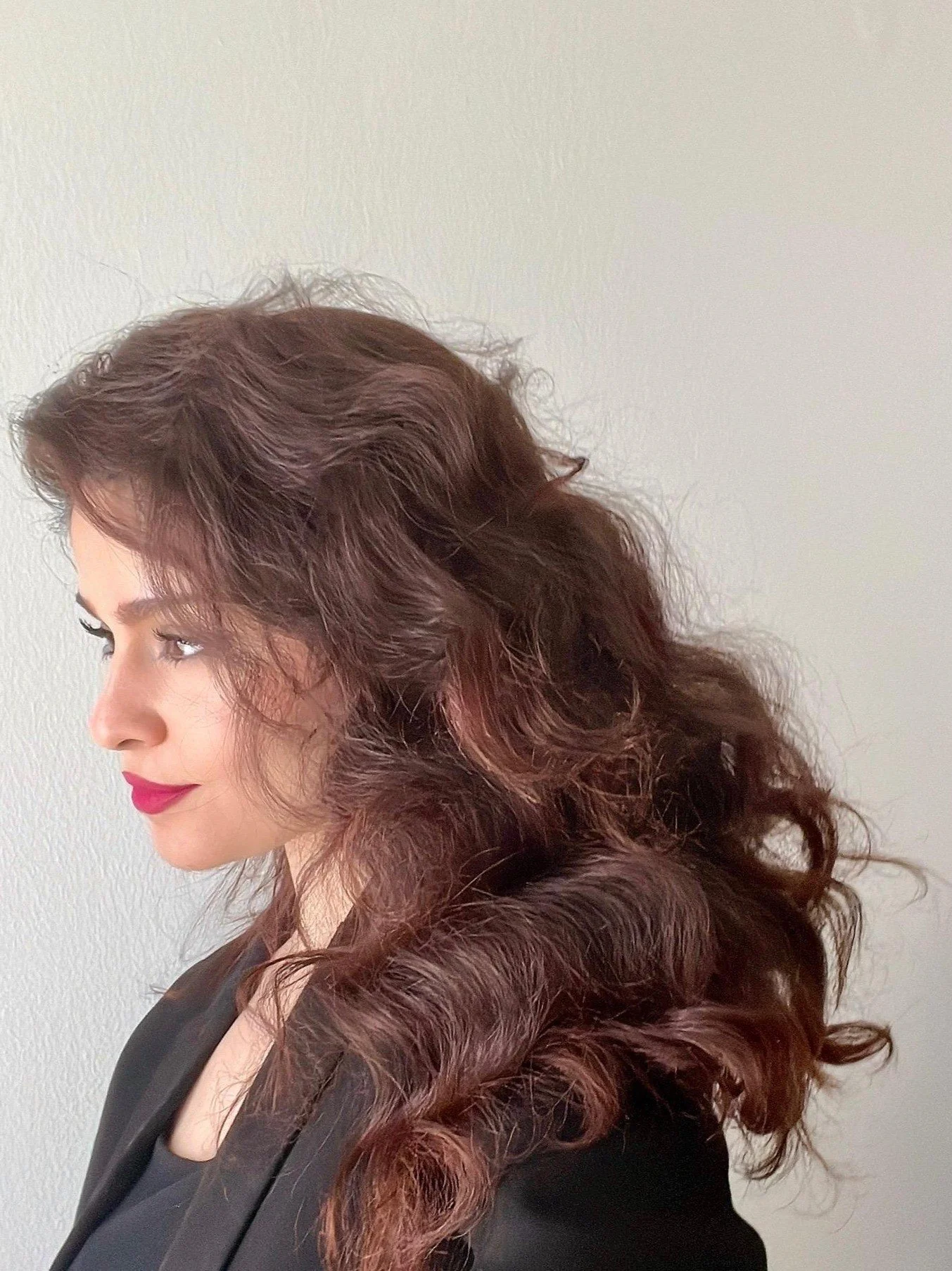
Aya Chalabee was born in Baghdad and lives in Helsinki. She holds a BA in interpreting from Diaconia University. No Sun in Baghdad لا شمس في بغداد is her first short story collection (2015) and Two Friends in Urصديقان في أُور is her latest (2021). Her works also appeared in the Eksil anthology by Screaming Books (Denmark). She has translated the children’s book Siinä Sinä Olet from Finnish to Arabic 2021 and participated in Linnun Neljä Laulua 2022 book and Tilkkutäkin alle 2026 book as translator. Beside writing, Aya works as a journalist, holds a fine arts degree and loves to discover places.
Read Aya’s “Behind the Essay” interview in our newsletter.
Header image by Juli Kosalapova.
Edited by Aube Rey Lescure.