Goodbye to My Circus Town
Sarasota is other people’s paradise.
My family moved there in 2000, when I was ten years old. Florida’s reputation is founded on wildness, untamed maximalism, and entertainment—a magic recipe for tourism. Visitors from all over come to Sarasota to spend their money on fine-dining seafood restaurants, fishing expeditions, waterfront condos, and high-end shopping, but its biggest allure is the beaches.
Sarasota locals add another allure to the idyllic coast, gathering for drum circles and dancing as the sun sets, twirling fire as the waves glitter behind them. It’s a bizarre land of make-believe, where reality has a dream-like quality. On the surface, at least, you can be whoever you are, whoever you want to be. You can be a professional mermaid or a pirate, or go to “college” to be a princess at the most magical place on earth—or join the circus.
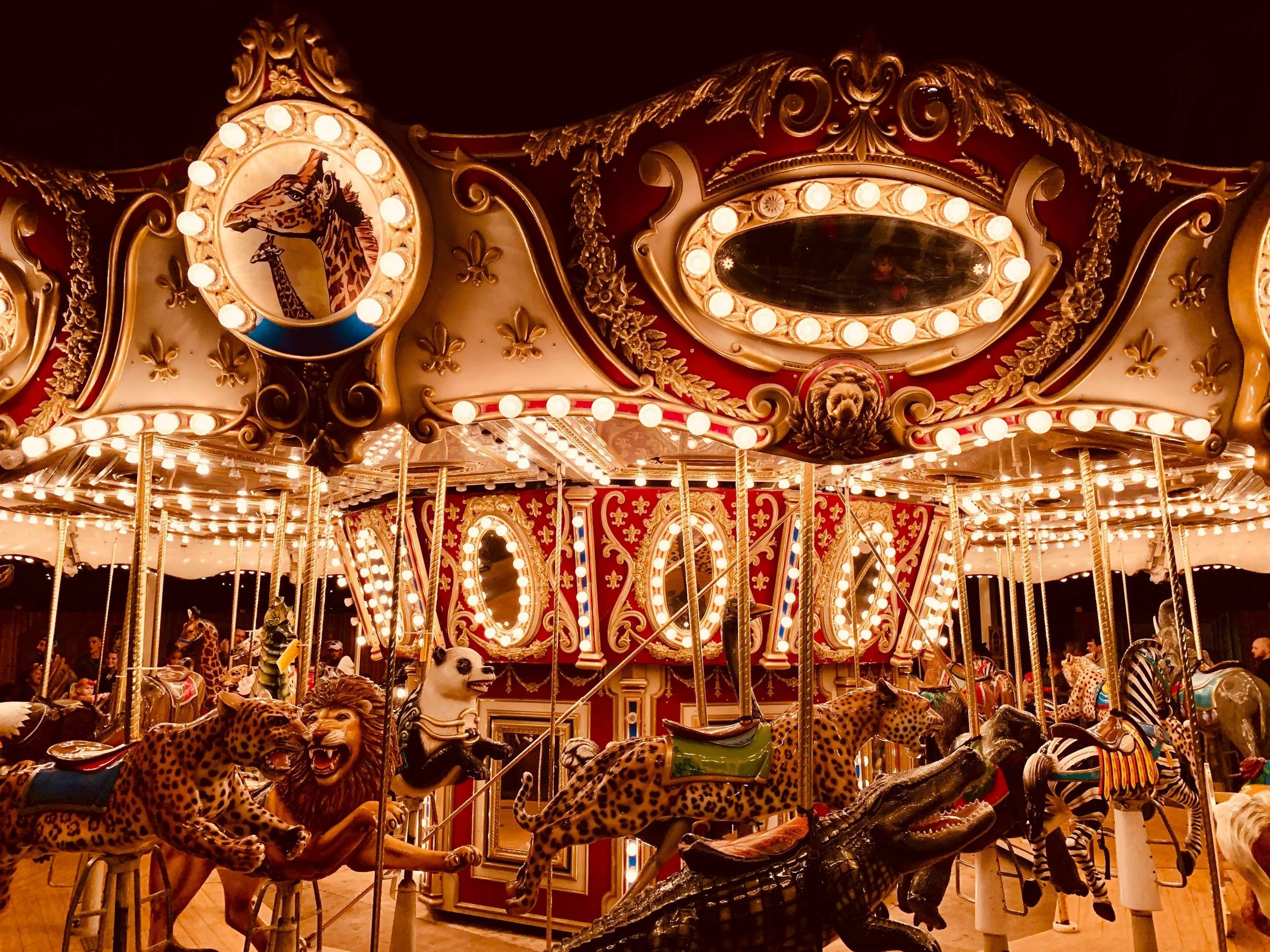
The Ringling Brothers Circus chose Sarasota as their winter quarters in the 1920s, and many circus performers and side show folks settled there, raised families, sent their kids to school, and ultimately retired. You could run into a contortionist at the grocery store, or play kickball with a tight-rope walker’s son. One of my friends learned to walk the high wire from The Flying Wallendas and performed with their youngest son. Near the athletic fields and tennis courts on my college campus, there was a large white tent where students enrolled in circus courses sport their bright costumes, rushing to their next class with clown makeup still painted on their flushed faces.
“It never shakes out of your towels completely and you keep finding the odd grain or two on your scalp. You’ll carry a little bit of it with you forever, wherever you go.”
Anyone who boasted an odd talent or medical curiosity could have a home in Sarasota, could develop an act that might make them famous, that might lead to a national tour or even a movie deal. To stardom.
Before moving here, my younger childhood years were spent out in the country in Louisiana, so I was already enchanted with the snakes, lizards, alligators, and marine life that inhabit Florida. I felt immediately at home with the wilds and wonders of Sarasota. When I wasn’t out in the yard or in parks, I was inside reading or writing stories about talking animals. When I started school in Sarasota, I met other kids who were just as in love with nature and reading as I was. I started to come out of my shell, played team sports, and joined writing and film clubs at school.
We lived fifteen minutes from the beach, and it really was paradise. The Gulf of Mexico’s protected waters are calm and warm. You can swim year-round, though it’s too brisk for most locals in the winter. Through the crystal clear water you can see down to the bottom, to your feet shuffling in the sand as the shore slopes gently into the deep.
Elysian waters aside, Siesta Beach in Sarasota is known for its sand—bright white quartz, so superfine it’s soft to the touch, like powdered sugar. One breath can send a cloud of crystal into the air. And it finds its way into everything: The constant coastal breeze blows sand into your hair, into your eyebrows and eyelashes. Sand collects in the shell-like curves of your ears, under your toenails, in the chap-sticked corners of your mouth. It cakes around the oily neck of the sunscreen tube, along the warm wet rim of your beer can.
When you leave the beach, the sand gets on the car seats and floor mats, in the wedges of the A/C vents. It crunches underfoot on the pedals on the drive home. You wash the dried salt off your neck and hairline and rinse out your bathing suit, leaving a fine grit on the shower floor. You’ve brought the sand inside with you. It’s in your beach bag, in the pages of the book you brought but were too hot to read, in the charging port of your phone. It never shakes out of your towels completely and you keep finding the odd grain or two on your scalp. You’ll carry a little bit of it with you forever, wherever you go.
I started dating girls in high school. I don’t remember coming out, really, just that one day, I broke up with the boy I was dating because I thought I had a crush on a girl. The boy was kind of popular, and I was, well, not. When my Nokia candybar cell phone rang between classes, boys I’d been friends with since elementary school would scream, “Rug muncher!” and hang up.
It didn’t go well at home either. I got caught kissing a girl goodnight in the driveway and was sent to therapy. I sat in silence on a cold leather couch across from an old man who told me I was sick, that he and God could help me. Then another therapist, and another. The third one was a young woman. She had me read aloud to her from my journal and tell her about the stories and poems I was working on. She was the first person outside of my English teachers who encouraged me to write. And she gave me another even more important gift: She told me that while I might want my parents’ acceptance, I didn’t need it. It was like being snapped out of hypnosis; I was suddenly awake. And free.
Growing up, I’d had this perception of Sarasota as a welcoming place, where those who were different weren’t just accepted, but celebrated, venerated. It was a place for the arts and entertainment, the circus and the theatre—spaces that were undoubtedly inhabited and proliferated by queer folks. It wasn’t until I came out as a teenager that I began to notice—to feel personally—the overwhelming truth. You could be a mermaid, a princess or a prince, a pirate, a side-show curiosity, a fire juggler, but you couldn’t be gay.
And yet, as an upper-classman and then as a young adult, I found there was no lack of us. Some of my close friends had come out, and I’d made new queer friends at house parties. There was one gay bar in town I knew of that was 18-and-up, in a strip mall that looked abandoned after dark except for all the fabulous people smoking cigarettes under the awning out front and the dull thump of bass coming from inside. The first time I went to Pride was in Tampa the summer after high school. I was overwhelmed by the crowds—the sheer volume of us—and by how much love I felt gathering with thousands of Florida queers and allies in a single day. Why couldn’t the people who hated us, who wanted us to live in the dark, feel this love? I almost pitied them. But Pride was the exception, a dream-within-a-dream. We all had to go back to reality on Monday, to face our bigoted boss or co-worker or family member. The joy I had felt at Pride and in the small queer spaces I’d found still couldn’t outweigh my overwhelming desire to leave.
And then all the color seemed to drain out of the town at once, when the opioid epidemic arrived at our shore. OxyContin cast its shadows over our beach town and communities across the state of Florida. No one was safe. The queer community I had just started to find joy and belonging in was no exception. My girlfriend became addicted when she was prescribed Oxycontin after an accident, and I watched helplessly as the last of the light magic of Sarasota was swallowed into the dark.
“You could be a mermaid, a princess or a prince, a pirate, a side-show curiosity, a fire juggler, but you couldn’t be gay.”
The vibrance of Sarasota began to fade as I realized that the home I loved didn’t always love me back. After earning my bachelor’s in-state, I began to dream of leaving. I wanted a fresh start somewhere new, maybe someplace above sea level, with old-growth forests or mountains. Somewhere I could be myself, be part of a queer-friendly community, and be a writer. I started looking for work and opportunities that would carry me away to that new life. My partner got a job offer in North Carolina and he took it. It was our ticket out. That was thirteen years ago.
When I finally left, I felt like I had run away. Like leaving home meant I had given up on it. Not just the place, but the people I left behind there. I should have stuck around to help heal the town and myself. But I was ready to move on, ready to experience something besides chaos, to take what I had left and start over somewhere new. I still miss Sarasota, its crystal sands and circus stars. I dream about the ocean every day. I might have been able to leave, but I can close my eyes and smell the way the Gulf air mixes with heat and salt and water. I’ve never been able to let go of it. It is the sand in my ears.
About the Author

Arielle Hebert is a queer poet based in North Carolina with roots in Florida and Louisiana. She is the author of Bottom Feeders (Black Lawrence Press). Her poems have appeared in The Slowdown, Academy of American Poets’ Poem-a-Day series, Poetry Daily, Best New Poets, and others. Arielle is the 2025-2026 fellow at Hellbender Gathering of Poets, an annual writing conference celebrating poetry, environmental science, and community to bring about a joyful rising in a climate-changed world. She is the Director of Operations and Marketing at Blair, a nonprofit publisher focused on emerging and diverse writers. Arielle believes in ghosts and magic.
Read Arielle’s “Behind the Essay” interview in our newsletter.
Edited by Tusshara Nalakumar Srilatha
Header photo by Eric Tompkins