5 p.m. in Woolwich
5 p.m. is the hour when my baby fights sleep. The river at low tide smells of shellfish and mud. The city quiets as people get home. The odor of stir fries in hot oil and ovens crisping sausage rolls slips through windows into the courtyard. Beyond the buildings, the ferry claxon echoes over the water. The minutes stretch, grow infinite. The last sun glints off a stairway clinging to a block of flats.
Recovering from childbirth, sinking deeper into the couch, I nurse my baby. Dusk thickens. A musky scent rises from my baby’s head, a reminder of laboring through sunrises, sunsets—lying down, standing, pacing, squatting, crying, falling quiet—anything to push beyond the rim of pain, to bring my newborn back from the other side. Now, three months later, she’s here, her body hot and swaddled, cradled to my front. She presses her hand to my chest, fingers spread, intent on her task. I shore up her head lolling in the crook of my elbow. My muscles sore, I wonder at the moonlike curve of her cheek, translucent with down.
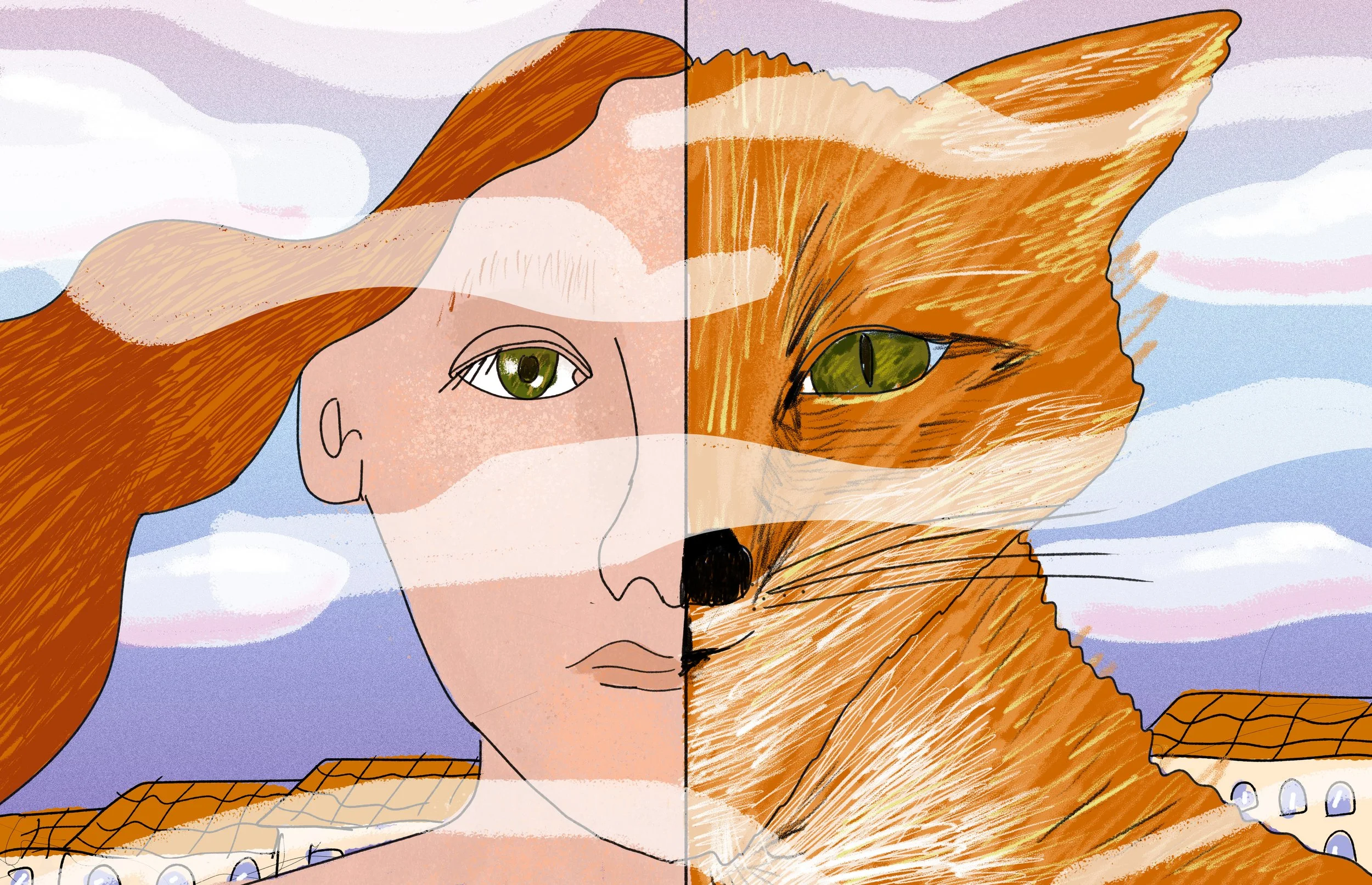
Evening thickens to purple. A neighbor’s humming weaves through the courtyard as windows light up. In moments like these, with twilight deepening, the present thins to nothing more than a curtain of gauze. Once, this land was a testing ground for munitions, for the proving and storage of ordinances, gun carriages, fireworks—a hoard of gunpowder filling a dovecote near the shot-yard. When I was heavy with child, returning to my flat after teaching late at night, I was the only person moving along the yard’s cobblestone lanes. Fog crept in from the river, the silence ghosted with voices, the stockrooms’ bustle, laughter from the barracks, explosions of roots and dirt. Once, at the corner, a fox paused in her nocturnal circuit, sensing my presence. I stopped, stood still. The fox, illuminated by the streetlight, turned her head to look at me. We regarded one another. Somewhere, nearby, she’d found a den—an earth, as it’s called, in the riddled underbelly of these acres. I rest my head on the couch and watch the rooftops dissolving into the sky, knowing she’s out there now, roaming, scavenging for her cubs, the streetlights a string of jewels twinkling along the spacious grid of the arsenal’s roads. Foxes earth in abandoned places—near dense-pruned forgotten trees, under sheds, in ruins—bringing seeds that make new plants, turning the threshold of the den to a rich hearth.
When I stand up, my baby wails. I’m sleeping in two-hour stretches, never more, in a bleary tailspin of love and exhaustion. Tears prick at my eyes. Blood rushes to my head. My throat tightens. I shift my gaze to look outside. And there in the window I see a reflection, a burning emblem—the fox’s face, turning toward me, flickering with light, with wildness, showing me how to dig down, to dwell in this temporary adopted state of dreams until the halls that shelter me widen and let in the world, the old slick-sided buildings drifting in the fog and shimmering rainclouds as I step out into the night.
About the Author

JR Fenn is a multi-genre writer whose work has appeared or is forthcoming in Boston Review, The Georgia Review, Witness, Split Lip, and more. Her fiction chapbook, Tiny Vessels, won The 2024 Masters Review Chapbook Open and is now available from Red Mare Press. Recognitions include the New Millennium Award for Flash Fiction, the Robert Colley Prize for Fiction, the Gulf Coast Prize for Nonfiction, Pushcart and Best Small Fictions nominations, and appearances in the Bath, Bristol, and Oxford Award Anthologies. Her writing has been supported by Ucross, Orion, Writing by Writers, and the Key West Literary Seminar, among other places. She teaches Fiction and Environmental Writing at SUNY College of Environmental Science and Forestry and lives in Western New York with her family. Read more at her website.
Illustration by Jane Demarest.
Edited by Tusshara Nalakumar Srilatha.