Raumforderung
Raumforderung
German, noun
Mass
I walk to the clinic through the damp seaside dark but come in too soon, before the morning shift arrives. The rumpled young man doing my intake has been up all night. I show him a picture of my blood in the sink. I show him my insurance papers and my ID. I show him that I can speak German and that I understand his questions. I am causing a lot of paperwork and a lot of muttering. I sit blithe and still on the examining table as needles and electrodes and heads of stethoscopes swarm and bite and stick on me. I take my shirt off and put it on again, courteous and compliant. I go to radiology and come back. I get up on the table once more, not knowing that after today, I will never stop getting up and down off tables. I will never go home to a healthy body.
A Raumforderung is a description, not a diagnosis. If the doctor in Bremerhaven leans against the counter in the last 20 minutes of the night shift and tells you there is a Raumforderung in your lung, it means that something is large where there should not be anything at all. Something is growing into space where there is no space for it to grow. A Raumforderung is crowding the alveoli, bronchiolae, blood vessels, and clever segments that exchange carbon dioxide for oxygen in the constant commerce between my own small galaxies inside and the awful world without. My soul is knit to my body each moment only by pulling the strange outside close and pushing it out again. Raumforderung means something big and wrong is making it hard to live.
“I will never go home to a healthy body.”
My father thinks he is German. In fact, he was born stateless, but he still fussed until I dropped French and added German during college in the U.S. I learned more when I came here, studying doggedly until Germans stopped squinting at me when I spoke. I learned German well enough to bellyache and boss strangers around, to read Kafka and watch Brecht. I learned German to get around the restless chaos of my American father who was born here and my Ukrainian grandfather who was trafficked here. I wanted to know the language from before my family migrated, before the war, from back where folks favor being quiet and staying put.
I was already on the road to meeting the word Raumforderung long before I started learning German. Inside my chest, in the good little galaxy of tissue and breath, each gene in each cell was at home and had good work. One day, two genes on the twelfth chromosome inside one single cell in my lung slipped a little and fused together. Their collusion was indolent but relentless. They built something large and wrong, cell by cell, weighing down each breath with sick encroaching growth. That secret slow-killing thing in me began its bad work when I was 14, the same year my Ukrainian grandfather drove his truck into a tree in Wisconsin and died.
Now on the flat north coast of Germany, I am sitting in the ER in Bremerhaven. I came here to visit the migration museum, built on the port where ships carried away displaced persons after the war. My grandfather, his German wife, a kindergartener who became my eldest aunt, and a baby who became my father got a place on one of those ships in 1951. I have all their papers: ID cards, ration cards, even the ship's manifest from the USS Sturgis. Every name on the list is Slavic.
The little family which the work of time would make my family were on a boat full of displaced persons. The Nazis had trafficked millions in to Germany from Eastern Europe to be forced laborers. After the war, the International Refugee Service re-categorized them as displaced persons, requiring them to get out of Germany. Many, like my grandfather, married German women as the flood tide of ruin soaked in around their knees. Neither their wives nor the children they fathered nor the long years of trying counted towards the right to be at home in Germany. Their little families were tallied on their ration cards and entered into the calculus of mass resettlement programs. They carried their bags of loss and their stateless children onto resolute ships and went yet farther west. Seventy-five years and two generations later, I am back in this port town but not where I want to be. Instead of being a cheerful woman getting coffee and digging through archives, a researcher on a research trip, I am a case of massive hemoptysis.
I was just getting dressed to go to the museum, to be an academic looking at past misery from a secure distance, when I coughed up blood and then stood staring at the atrocious fact before me: blood in the sink. I tried for twenty years to find a doctor who would tell me why I sailed so slow through life, dragging an anchor I could never weigh. Instead I found doctors who tested my thyroid then shrugged. They searched in my intestine or my mind, suggesting I was depressed or lazy or greedy for ease. A big wrong thing in the lung does not feel like something is wrong with your lung. It feels like something is wrong with everything.
The Nazis invaded the Ukraine and issued my grandfather papers declaring him the fruit of an inferior race fated to serve them. In that first ID photo from 1941, he is wearing his Sunday suit, hair neatly parted and combed back, a smart young lad still believing that he is free to set off from his starving home and get good work in Germany. In fact, he is a teenager who will never see his home or his brothers again. The last photo is on ID papers issued by the French in 1945 declaring him a displaced person. It shows the bad truth plainly. He is haggard, head shaved, eyes blank.
The bad truth about my body arrives from radiology: I have lived all this time with ballast on each breath. I did not learn medical German. In medical German, they say things like Raumforderung when the doctor is pointing at a chest x-ray on his monitor. The word Raumforderung has lain in wait all this time just to leap out and tell me the big wrong thing I have carried so near my heart for so long has now grown so big it constitutes a demand (Forderung) for space (Raum). I know what each half of the word means. But I do not comprehend the significance of the whole any more than I was able to comprehend the thick puddle of blood I coughed up into the sink of my AirBnB: Splat! Splat! How, after diligent decades of yoga and vegetables, could I have arrived at a place where things are quite this wrong?
I am American and the doctor is Syrian and we are speaking German to each other here in the ER. We are both trying to be at home in a country that has pulled in and pushed out millions of people. We have learned this language with the desperation of migrants everywhere. No matter how much loss you are already carrying, never mind how heavy your stateless children wriggling in their coats, there is always more that could slip and fuse and grow all wrong.
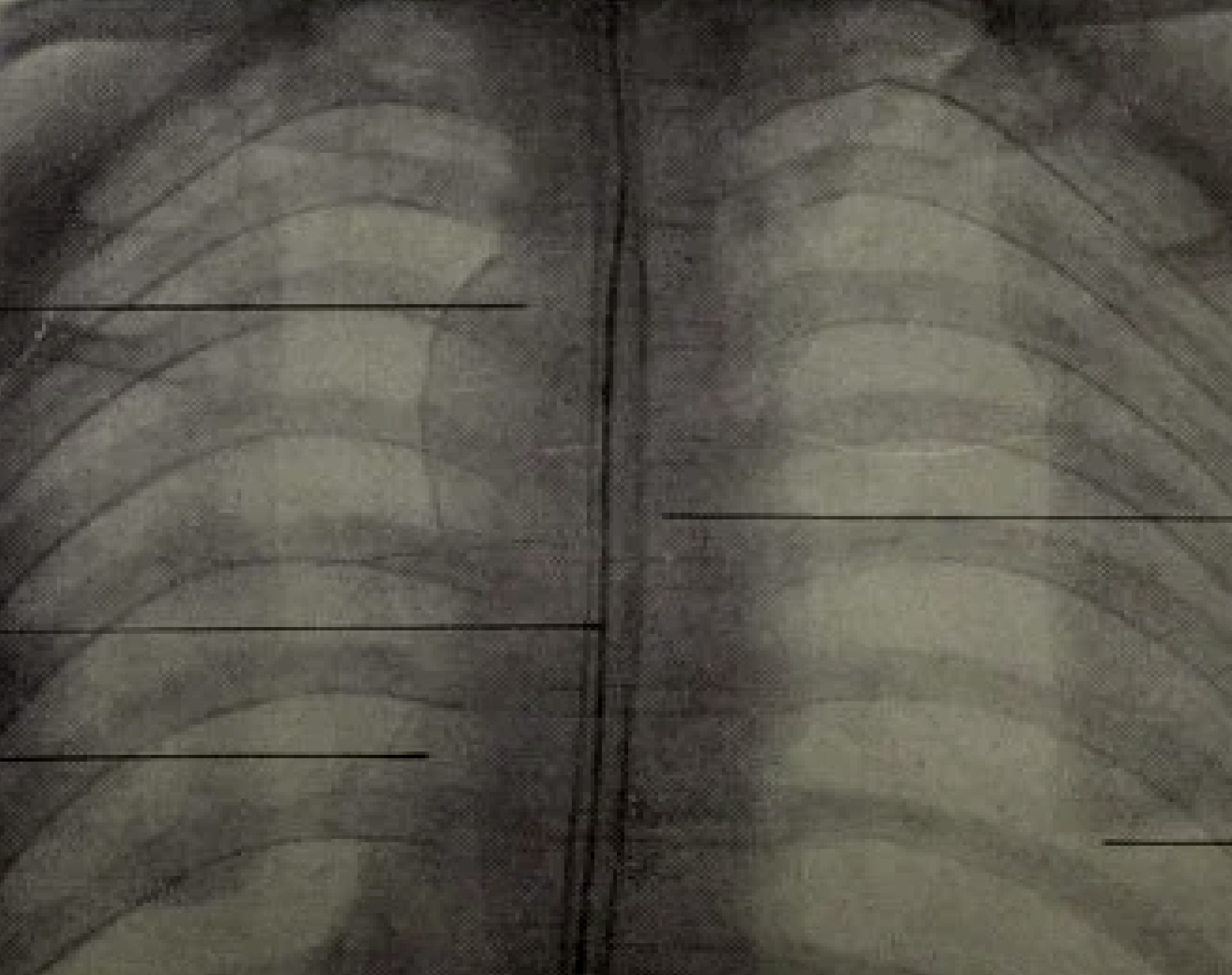
The thing on the x-ray the Syrian doctor is calling a Raumforderung is a fat white oval at the bottom of my left lung. It is the size of the ID card I just showed, eight centimeters long and five centimeters across. The night before my trip, I carried heavy boxes full of my late mother-in-law's good dishes. Bearing the weight of loss has caused the fragile blood vessels the silent tumor had built for itself to rupture and bleed. Blood seeped out into my lung. I coughed a little on the train, I coughed a little as I got settled in my AirBnB. Then I coughed a lot and the truth went splat, right into the sink. The doctor tells me they have to admit me. No, I may not go back and collect my things. My research fades to nothing.
I know the word Raum as in Lebensraum, which is when Nazis decide they want your country, that it's time to drive their tanks into Poland or take Ukraine after all. It means my 18-year-old grandfather was put on a train going west for a long time, his body never to move east again across the wide face of the earth towards home. When school textbooks say Lebensraum they mean habitat, the natural area in which a given animal or plant prospers. The illustration shows a tiger in the jungle, a frog in a pond, a whale in the deep blue sea, all at home, right where they belong. Raum also simply means room, as in space, like room to breathe, growing room, room to maneuver or a room of one's own. Forderung means a demand or a claim, requiring a reluctant concession. The unions make a Forderung and the bosses have to answer to it. The tax office sends a Forderung and compels you to pay.
Raumforderung is a medical term arriving in my mind carrying more affect than information. I know that something improper and unwilling is happening. Instead of the valiant ingestion and revolutionary expulsion of the awful outside, instead of room for the paradox by which we all survive, there is crowding and concession. Displaced genes commanded wrongful growth, demanded space which could not be defended, and so was conceded, to a slow invisible thing, the bad truth I could ever only have failed to escape.
“There is always more that could slip and fuse and grow all wrong.”
When I was little, my unruly father took me to visit his parents in Wisconsin in a little house with a screen door that stuck. Inside, it was always dark and off-kilter, swarming with badly bruised English, farm German, and the mad lyricism of unspeakable grief. My grandfather was no longer a Ukrainian boy in his Sunday suit nor a prisoner empty-eyed after the war. Now, he was a swarthy little man in his undershirt who rambled around hassling people from within a thick haze of trauma and booze. He shuffled into the kitchen with each newly emptied can of beer, trying to speak to me in German. I cast down my eyes and backed up against the undreaming walls, afraid of his meaty hands and their missing fingers.
Around behind the little house, my grandfather tended an overflowing garden. It burst out everywhere with Van Gogh-yellow sunflowers, glaring red poppies and fat strawberries, snap dragons and runner beans, roses and potatoes. There is a photo of me and my grandfather, polaroid-faded, on a summer day in that garden. I am a two-year-old in a bright blue sundress. My grandfather is in his crucifix and undershirt driving me around in his wheelbarrow amongst high sunflowers and wide beds of screaming color. I sit as docile as I would in the ER, waiting to be capsized and climb in again. We both look right into the camera, our faces alert and silent, caught in a game too rough for a little girl, in a world too rough for any of us. We both knew back then, in our strangely linked bodies, in our genes and in our breath, back before he drove his truck into a tree and my one cell slipped, that we can only grow—whether there's room or not—that survival is just as heavy as loss.
ABOUT THE AUTHOR
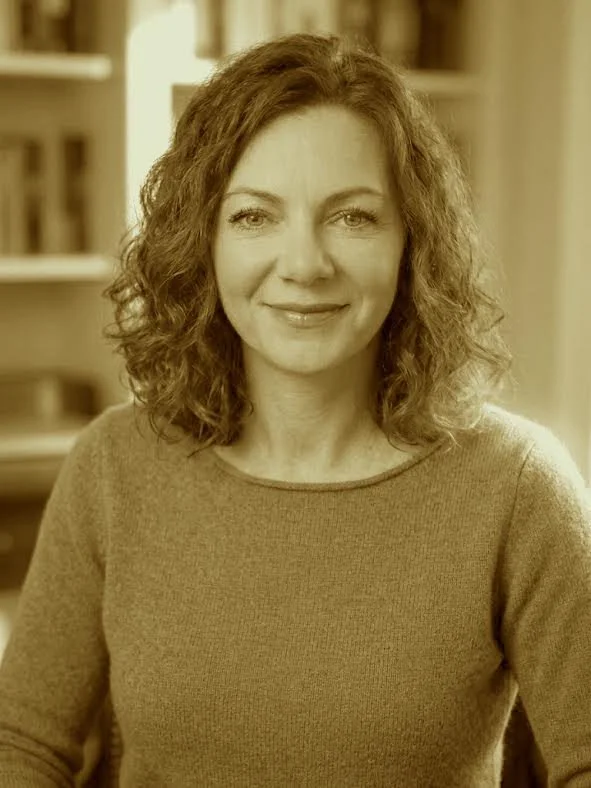
Blossom Gordana Champlain is an American scholar and writer who built her academic career over 20 years in Germany and is now based in Oslo. She has lectured and published widely on religion in Late Antiquity and on feminist historiography. Her debut creative non-fiction piece appeared in 2025 as runner-up for the Margarita Donnelly Prize for prose at Calyx. She only has one lung.
Read Blossom Gordana “Behind the Essay” interview in our newsletter.
Header photo by Cunningham's Manual of Practical Anatomy 7th ed.
Edited by Tusshara Nalakumar Srilatha.