
What Do You Have to Lose: Reading Edward Abbey in Arizona
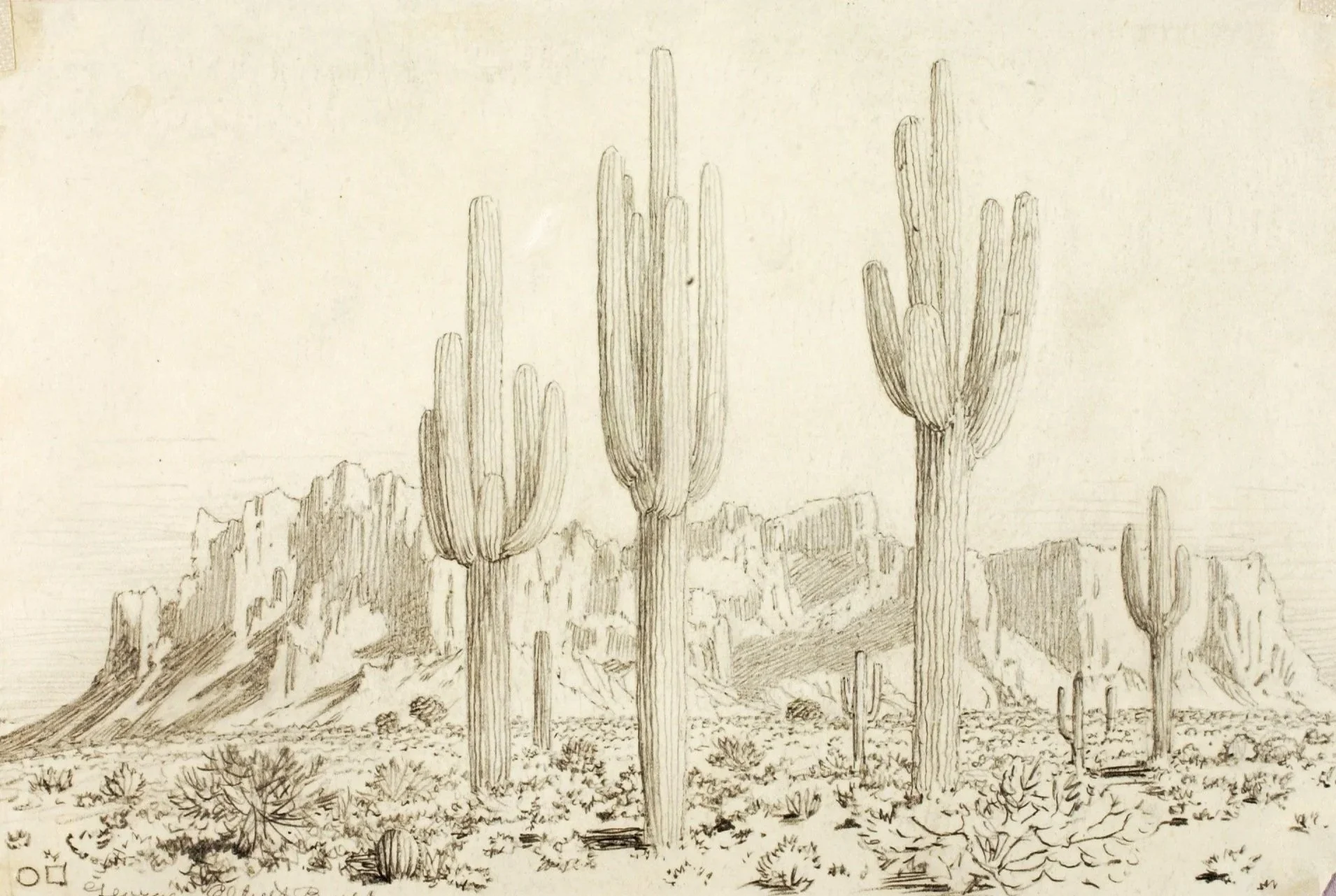
I had never seen saguaro, nor did I realize Arizona contains most of their population. They appear on the state’s license plates, an iconic cacti composed of a narrow tubular stalk, spiked and vertically striped. They towered over houses my partner and I passed in Phoenix, standing goofily independent and thickened, entering Tonto Basin into full groves.
It’s hard not to anthropomorphize saguaro, with their humanoid proportions, their arms reaching ever upward. En masse, on the brightest hillsides, it seemed they had gathered to worship the sun. Their spines are as sharp and strong as leather needles, clustered into fanged groups, but if you can get past these, the flesh is as smooth and cool and firm to the touch as manzanita, whose bark is like skin.
Cacti surrounded our cabin rental. Some of them were black on the bottom, as if dying from the ground up. Was that normal? I had no idea. We were in a sparsely populated valley, with mountains on all sides.
The nearest grocery to our rental was a hardware-store-marketplace-gas-station-deli with a mound of Trump hats at the counter. The second closest shop had a plastic skeleton hanging from a noose outside with a t-shirt saying Dead Pedophiles Don’t Re-Offend. The gravel road leading to our cabin had a turnoff reading Trump Train Alley. The cabin itself was cowboy-and-Christian themed, with a crucifix resembling a tooled leather belt buckled at the cross point, and illustrations of cowboys praying or raising cruciate wood.
I was wearing what my partner called heterosexual drag. I’d grown my beard out, gotten a ball cap from a local thrift store, brought shapeless canvas work pants. Was it necessary? I’ve had enough experiences being stared at, screamed at, spit at in conservative places—especially early in my gender transition—not to want to stand out when I have the option of blending in. By the time we got to Arizona, I had the luxury of passing, but was still (I think) obviously an out-of-towner: Jewish, progressive, urban. My partner is mixed-race. Everyone around us looked white. Hiking in the cacti, it didn’t matter. Around people, there seemed to be a thousand subtle signals we did not belong.
I was depressed, I admit, at the start of the trip, by the political schisms in the U.S. and the wider state of the world. I wanted to escape to the backcountry; to take a break from arguments and headlines, to bathe in land’s salve. Yet for the first few days, I couldn’t seem to take in any of this—the hills or peaks or rolling green. Every venture down the main road brought a new fantastic landscape, though the only difference was my ability to catch it. Every time we drove the stretch of road before our cabin, I noticed new saguaro I had missed the last time.
It was hard to be present, partially, because the political had followed us—not least in the results of climate change on the Tonto Basin itself. The area is dryer, hotter—at risk of drought and dangerous floods. I thought constantly about everything in the news cycle causing me rage or despair. I worried about whether I passed and how my partner and I were perceived. It took long exhausting days of hiking for my sense of separation—from both the landscape and the people around me—to ease.
“And yet there is an incredible sense of freedom in the open landscape, where so much sky can be seen, so much land from the mountain basins, inextricable from its dangers.”
In the mornings, I woke before sunrise, when stars show in blackest night, and brought watery cooling coffee outside as the first brightening rose past the highway. When the grounds grew light enough, I hiked up the road and onto a trail where I could see the pinks and oranges of a new day, and stood there until the sun crested, blinding, over the range. When light finally reached me, I pulled my coat off. The only sounds were of birds, lowing from the cattle farm, and lone cars, with their headlights still on, echoing over the road.
There were sunsets too, of course, and the first one caught us by surprise as we hiked up a saguaro and green brush trail. We’d miscalculated the time difference from the East Coast and had to race back, craning our necks to catch the light show, until the sun sank totally, and we were left slipping down a rocky descent in the dark and cold. The car was parked in an unlit turnoff and, in our confusion, my book fell out of the door. We found it the next day on the gravel lot, where it had been run over at least once, and gone sodden with dew. The cover was pocked and ripped and missing great chunks, but miraculously none of the actual text had been harmed.
*
To be honest, Desert Solitaire had bored me the first time I read it in my early twenties. It follows the author, Edward Abbey, and his experiences as a ranger at Arches National Park in eastern Utah for two seasons in the 1950s. From April to September, Abbey lived in a government trailer, making himself available to tourists, maintaining campgrounds, wandering, adventuring, sitting, thinking, and collecting visitor fees. I preferred Abbey’s novel, The Monkeywrench Gang, following a motley group of ecologically minded saboteurs in the 1970s, attacking billboards, bulldozers, bridges, and anything defiling the southwestern deserts. Their goal was to blow up the Glen Canyon Dam to liberate the Colorado River—and though they do not succeed, the book helped inspire the real-life Earth First!, whose direct-action tactics include industrial destruction.
The Southwest is a harsh place for those unprepared to be there. Dehydration and heatstroke are risks, the sun burns, the nights freeze; there are lethal venomous predators, sheer drops on cliffs and mesas, flash floods. And yet there is an incredible sense of freedom in the open landscape, where so much sky can be seen, so much land from the mountain basins, inextricable from its dangers. Used to the lush and mossy forests of the Pacific Northwest, I brought Abbey’s book because I remembered it had wonderful evocations of the desert and I thought he could help me appreciate the place for what it was. I wanted to sink enough into a landscape—any landscape—to forget my tangled relations with humanity as a whole.
And it worked. He called the desert sun a “flaming globe, blazing on the pinnacles and minarets and balanced rocks” among “the red dust and the burnt cliffs and the lonely sky,” and I looked more closely at the rocks and red dust, taking in the great expanses of land and sky mirroring each other in open splendor. He said, “One breath of juniper smoke, like the perfume of sagebrush after rain, evokes in magical catalysis,” and I remembered to check my own sense of smell, absorbing the sweet sunbaked scent of the earth and its scrubby verdure.
Because I veer almost terrifyingly cerebral, I knew I would be able to see things more clearly after reading his descriptions than I would just looking around with my eyes. What I’d forgotten, though, is how much the anarchist Abbey wove in politics. He is horrified by industry’s chipping away at, and the National Park Service’s building up of, Southwestern lands. Excoriating “anthropocentricity, the opinion that the world exists solely for the sake of man,” and pointing out, rightly, that for those adapted to the Southwestern deserts—like the Indigenous people inhabiting the region continuously for millennia—the place was wonderful just as it was.
“Most of what I write about in this book is already gone or going under fast,” he writes in the introduction. “This is not a travel guide but an elegy. A memorial. You’re holding a tombstone in your hands. A bloody rock.” The solution? “Don’t drop it on your foot—throw it at something big and glassy. What do you have to lose?”
*
I saw another trans guy in line for the bathroom at the gas-station-market-deli. He and his girlfriend looked young—much younger than they actually were. I saw the subtle signs of second puberty on him, and of queer hiking fashion. I clocked him, my partner clocked him, but I do not think he clocked me in turn. I tried to come up with some kind of recognizable comment to clue him in to our shared identity without embarrassing him or being parseable to others. “Excuse me, but are you a transsexual?” did not seem the right one.
In the car, on the way to another hike, my partner and I discussed this couple in detail. Why? In my regular life, I see trans people all the time. In New York City, where I live now, I wouldn’t have given him a second thought. I wanted him to notice me, I think, because it was uncomfortable to go stealth. In Arizona, not being openly trans made me feel like an interloper, like I did not have permission to be here, and that discovery (of my secret—which is not normally a secret) would get me ejected or worse. If we’d exchanged some heeding signal, I wouldn’t feel I was being covert.
Over the hike, I mulled over this potential interaction until we’d been away from people long enough that I stopped thinking about how I might or might not appear to others, and looked to the giant saguaro edging into the trail before me instead. Here was the appeal, I thought, in the solitariness of Desert Solitaire. In the company of plants, rocks, and my partner, I do not worry about any aspect of my identity, or social relations at all.
At his best, in the book, Abbey lets the flora, fauna, waters, and geologies of Utah take center stage. This is true of his actions as well as descriptions: When a rattlesnake takes residence beneath his trailerhouse, Abbey gets a spade and says: “I scoop the snake into the open. He strikes; I can hear the click of the fangs against steel, see the strain of venom. He wants to stand and fight but I am patient; I insist on herding him well away.”
“Perhaps what I needed was not surrender to isolate nature, but a surrender to the ways places and people will always be joined.”
There is a fantasy here, for me, of communing with pristine unpeopled nature, abandoning the self to let rattlers and rock forms come through, but the author does not let me indulge. The entire reason he is there, in a National Park, is because the place has been sectioned off and prepared for tourists; a few pages later he is ranting about plans to develop visitor centers and roads. Some of his politics I agree with. Others are uncomfortable. Mankind, in his book, is male-kind. Among the necessary skills he lists for park rangers is the comforting of women in thunderstorms. There are no intimations a woman might herself be a ranger. There is a long section on the necessity of Americans owning private guns. Queers (“fruits”) are invoked as specter to emasculate the men of whom he disapproves. I can’t imagine him impressed by a person like me—not only transsexual, but unable to “saddle a horse, read a topographical map, follow a trail over slickrock, memorize landmarks, build a fire in rain, treat snakebite, rappel down a cliff, glissade down a glacier,” or even drive or handle a gun.
And yet his posturing and likely thoughts on my identity did not seem worthy of distracting from the many ways in which he remained a worthy guide. “It is not enough to fight for the land,” he said in a 1976 speech. “It is even more important to enjoy it. While you can. While it’s still here.” This was good advice. I was waiting, in some sense, before seeing that couple, for the human world with its troubling politics to recede enough for me to lose myself in nature. I wanted permission and separation—but everything mashed together. Perhaps what I needed was not surrender to isolate nature, but a surrender to the ways places and people will always be joined. I was hiking a beautiful trail on a sunny day away from everyone but my partner, under miles of electrical wire and in sight, sometimes, of a road. Every so often, the prickly pear and saguaro were interrupted by telephone poles. Why not, I wondered, stop waiting and open myself to Tonto as it actually was? All round me were enormous anthropoid cacti, up to 50 feet in height, up to 200 years old. Why not listen to and enjoy them? What did I have to lose?
ABOUT THE AUTHOR
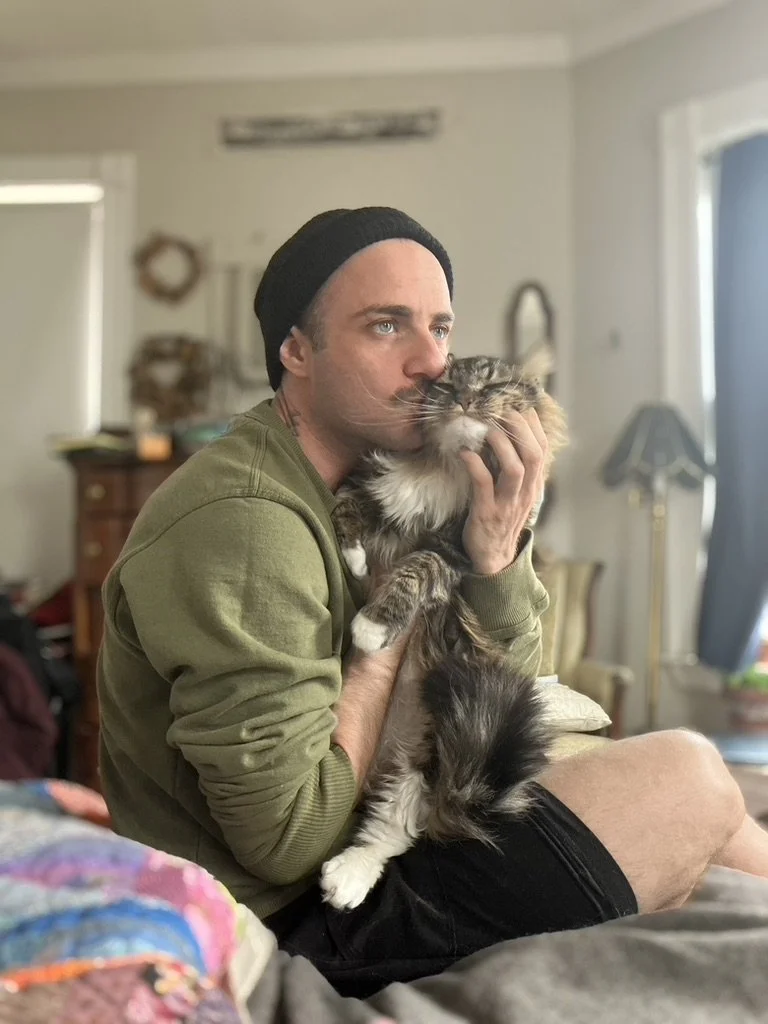
Calvin Gimpelevich is a former NEA Fellow, the recipient of a Lambda Literary Award, and the author of Invasions (Instar 2018). His work has been recognized by Artist Trust, Jack Straw Cultural Center, 4Culture, CODEX/Writer’s Block, Studios at MASS MoCA, and the Kimmel Harding Nelson Center for the Arts; it has appeared or is forthcoming in Ploughshares, Joyland, Kenyon Review, Los Angeles Review of Books, A Public Space, Best American Essays 2022 and Best American Short Stories 2026. He founded the T4T Reading Series in Boston, MA.
Read Calvin’s “Behind the Essay” interview in our newsletter.
Header photo courtesy of the Smithsonian American Art Museum.
Edited by Aube Rey Lescure




“I had never seen saguaro, nor did I realize Arizona contains most of their population. They appear on the state’s license plates, an iconic cacti composed of a narrow tubular stalk, spiked and vertically striped. They towered over houses my partner and I passed in Phoenix, standing goofily independent and thickened, entering Tonto Basin into full groves.”